 CUBE Chatshaala – Discussion Summary
Date: 10 November 2026
Tonight’s CUBE Chatshaala brought together twelve Cubists from several centres, with moderation by Arunan MC and Akanksha Joshi. The session circled around one connected question: how do antibiotics work, and what would they do to the very different living things we place them with, such as bacteria, germinating seeds and a green hydra? Aarya Takke, Manali Bhujade, Kiran Varma and M S Sailekshmi took turns as presenters. Akanksha Joshi also presented and moderated in the chat.
Effect of Kanamycin in Cardamine and Chlorohydra - CUBE chat - ChatShaala.PDF (1.7 MB)
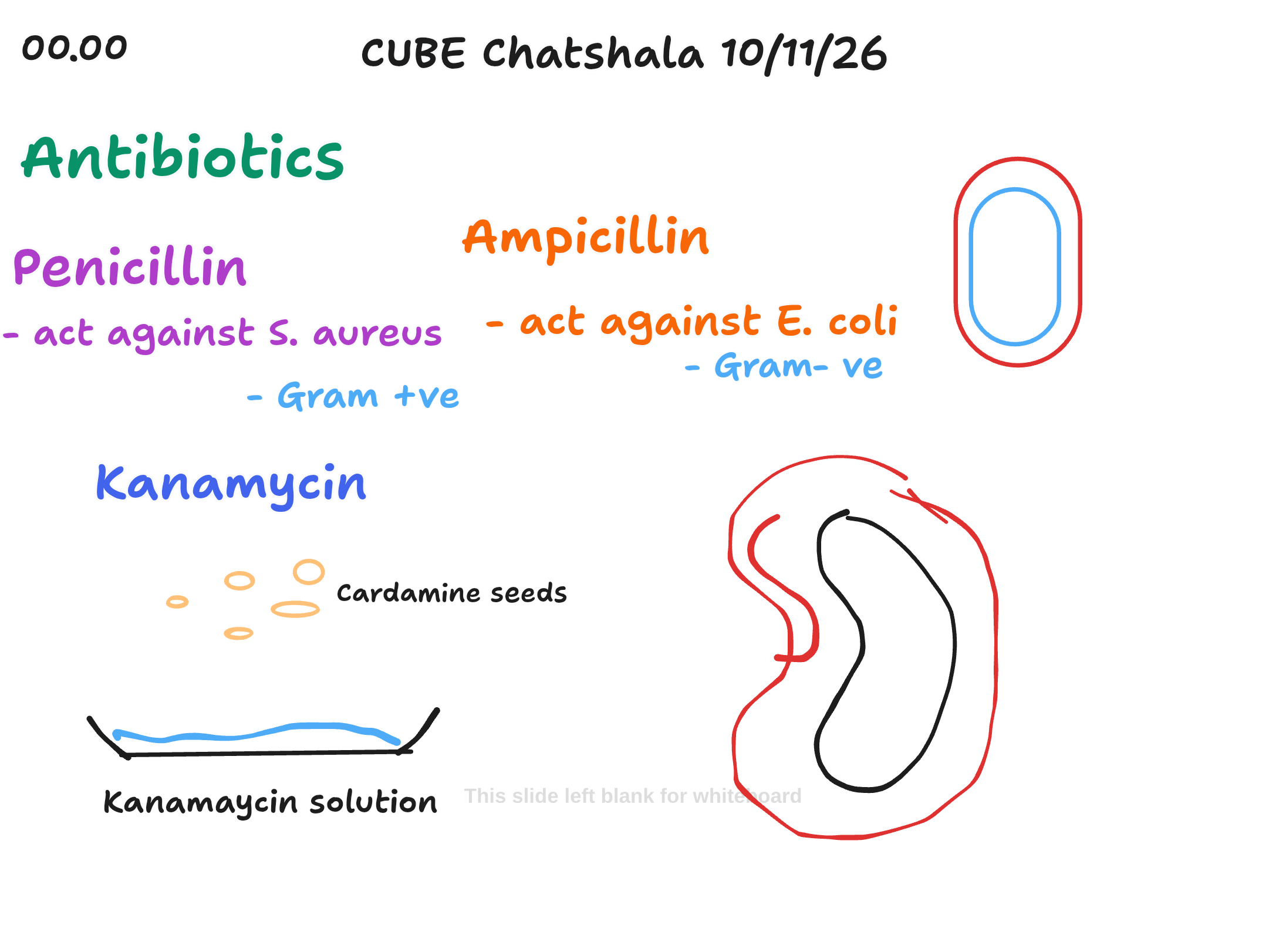
The first whiteboard (marked 00.00) was titled Antibiotics. Penicillin was noted as acting against Staphylococcus aureus, a Gram-positive bacterium. Ampicillin was noted as acting against Escherichia coli, a Gram-negative bacterium. Beside these were two cell outlines, a simple one and a double-layered one, which stood for the thinner-walled Gram-positive and the layered Gram-negative envelope. The third antibiotic, kanamycin, was drawn as a dish of kanamycin solution with Cardamine seeds above it, and a bean-shaped seed with an outer coat was sketched on the right.
This setup linked back to an older Metastudio thread, “Effect of Kanamycin in Cardamine and Chlorohydra”. In that thread, earlier Cubists asked whether Cardamine seeds germinate in kanamycin and whether Chlorohydra would lose its green colour when treated with it. Arunan MC asked Aarya to share her understanding of kanamycin in this context. He also posed a pointed question to the whole group: what is acting against the cell wall of green gram seeds? This tested whether we were treating all antibiotics as if they worked in the same way.
The chat added several threads. Arunan shared a reference page on Phyllanthus seed germination, noting that seeds germinate in about a week, can be maintained up to 20 days, and may germinate better if soaked in fresh water for 20 to 30 minutes before sowing. Later he shared the Wikipedia description of E. coli, highlighting that most strains are harmless or even helpful, aiding digestion, producing vitamin K2 and keeping harmful microbes from settling in the gut. Akanksha asked whether we had ever asked which antibiotic a patient was given and for what infection, and whether the strain of E. coli in our intestine matters. Both questions pushed us to treat “antibiotic” and “E. coli” as families of things and not as single items. Later she asked why we tested kanamycin on Chlorohydra at all, and then why Chlorella is green.
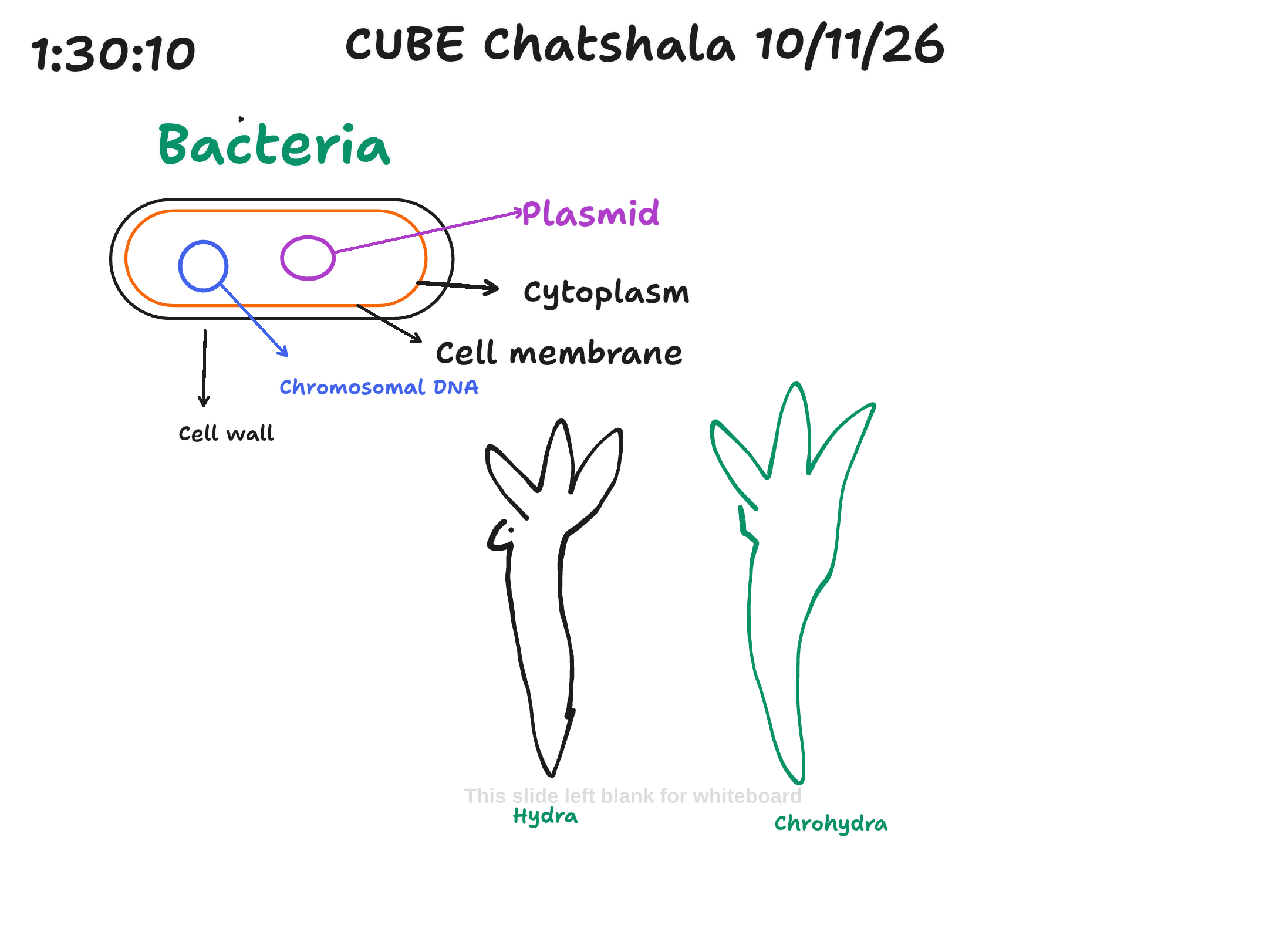
The second whiteboard (marked 1:30:10) was titled Bacteria. It showed a rod-shaped cell labelled with the cell wall, cell membrane, cytoplasm, chromosomal DNA and a separate plasmid. Beside it were two sketches of Hydra and Chlorohydra, which set up the question of why a hydra can look green.
Aarya stepped away briefly around 20:26 and returned at 20:51, after which she continued as presenter. Kiran was asked to carry on during the interval.
 Provocative Questions
-
Penicillin and ampicillin both interfere with bacterial cell wall building. Why does one get written against a Gram-positive organism and the other against a Gram-negative one on our board? Is the difference absolute, or only a matter of how well each drug reaches its target?
-
Kanamycin was drawn next to penicillin and ampicillin on the same board. Does it work in the same way? What does it bind to, and where does that happen in a cell?
-
If an antibiotic attacks the bacterial cell wall, what could it possibly do to the cell wall of a green gram seed? Is a plant cell wall even the same kind of structure?
-
Cardamine seeds in earlier experiments germinated in kanamycin, yet the seedlings grew poorly and lost colour. What does this tell us about the difference between germination and healthy growth?
-
The plasmid on our bacterial diagram is separate from the chromosomal DNA. Why do plasmids matter so much when we talk about antibiotics and resistance?
-
Most E. coli are harmless and some are useful. How should we think about killing “E. coli” with an antibiotic when the gut hosts good strains too?
-
Why would a Hydra, which is an animal, turn green? If we remove the green partner with an antibiotic, what happens to each of them?
-
When someone says “I took an antibiotic for a fever,” what three things should we ask before deciding the antibiotic was the right one?
 What I Have Learned
The biggest lesson was that the word antibiotic is not one idea. Penicillin and ampicillin work on the wall that surrounds a bacterial cell, while kanamycin works on the protein-making machinery inside it. Putting them side by side on one board looked tidy, but it hid a real difference, and the moderators’ questions brought that difference out.
I also learned to ask where a drug acts before asking what it kills. The question about the cell wall of green gram seeds showed me how easily I carry a bacterial idea into a plant without checking whether the target even exists there.
The bacteria diagram reminded me that a bacterial cell holds its main genetic material and a separate plasmid in the same cytoplasm, with no nucleus. That small detail becomes important once we talk about resistance.
Finally, the questions on E. coli strains and on which antibiotic was taken for which infection taught me that precise naming matters in biology and in everyday health decisions. Saying “E. coli” or “antibiotic” is rarely precise enough.
 TINKE Moments (This I Never Knew Earlier)
TINKE 1: Antibiotics differ in where they act. Penicillin and ampicillin target the building of the bacterial cell wall, whereas kanamycin belongs to the aminoglycoside group and binds the small (30S) subunit of the bacterial ribosome, interfering with protein synthesis. This was the reason the cell wall question had to be asked.
TINKE 2: Gram-positive and Gram-negative bacteria have different envelopes. The two cell outlines on the first board showed that a Gram-negative cell carries an extra outer layer, which helps explain why the same drug can behave differently on S. aureus and E. coli.
TINKE 3: Not every E. coli is a pathogen. Many strains live harmlessly in the intestine and contribute vitamin K2 and protection against harmful colonisers, so the strain matters.
TINKE 4: Kanamycin can still affect a plant, even though plants lack a bacterial cell wall. The reason is that chloroplasts and mitochondria carry ribosomes resembling bacterial ones, which fits the earlier observation that treated Cardamine seedlings showed poor growth and colour while still germinating.
TINKE 5: Chlorohydra is green because of a partner. The green colour comes from Chlorella living inside the hydra, and Chlorella is green because of chlorophyll. This explains why kanamycin was proposed as a test of the hydra and Chlorella partnership.
 Gaps and Misconceptions
Gap 1: The first board lists penicillin, ampicillin and kanamycin together under one heading without stating the mechanism of each. Adding one line per drug (cell wall, cell wall, protein synthesis) would remove the impression that they work alike.
Gap 2: Ampicillin is shown against E. coli and penicillin against S. aureus, but the board does not say that these are tendencies and not strict rules. Many strains of S. aureus resist penicillin, and resistance in E. coli to ampicillin is also common, so the labels need that caution.
Gap 3: The plasmid is drawn, but the board does not link it to antibiotic resistance genes, which is the main reason plasmids were relevant to tonight’s theme.
Gap 4: The experimental design with Cardamine seeds and kanamycin solution did not state concentrations, controls or what would be measured (germination, root length or colour), so the plan cannot yet be tested.
Gap 5: Spelling slipped on the board and chat, with “Chrohydra” for Chlorohydra and “Chlorela” for Chlorella. Correct spellings help others search Metastudio later.
Misconception 1: “Antibiotics act on cell walls.” This is true for penicillin and ampicillin but not for kanamycin, and plant cell walls are built differently from bacterial ones.
Misconception 2: “Antibiotics are medicines for plants and animals alike.” They are designed against bacteria. Effects on plants and hydra arise mostly through organelles that resemble bacteria, and not because the drug targets those organisms directly.
Misconception 3: “E. coli means a harmful germ.” Most strains are harmless or helpful, and only certain strains cause disease.
Misconception 4: “Any antibiotic will do for any fever.” A fever may come from a virus, where antibiotics do nothing, and the right drug depends on the infection, which was the point of Akanksha’s questions.
 Photographs during ChatShaala
 Reference