 CUBE ChatShaala Summary – “Seeds of Growth: From Fenugreek to Mustard”
Date: 27th October 2025
Today’s CUBE ChatShaala explored the conditions essential for plant growth and the comparative study of seed germination in mustard, fenugreek, and Cardamine. The discussion began with identifying basic growth requirements—sunlight, water, and minerals**—and how these factors can be simulated within a simple home-lab setup using pots, soil, and water.

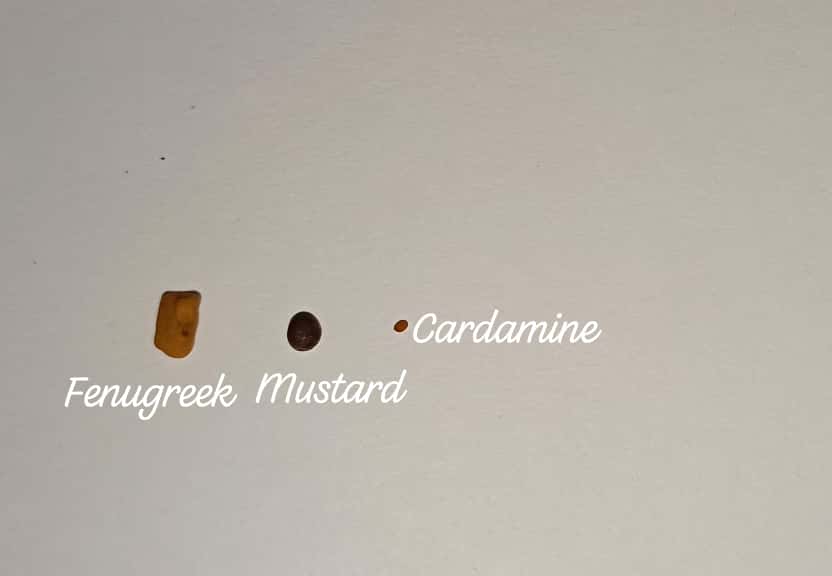
The focus experiment involved observing and comparing the germination rates of mustard and fenugreek seeds under similar conditions, aiming to understand which seeds germinate faster and how seed structure and size might influence germination. The participants also brought in Cardamine seeds as a point of comparison due to their smaller size and relevance in CUBE Homelabs experiments.
The visuals shared (seed setup and seed size comparison) helped the group recognize clear differences in seed morphology—fenugreek being the largest and Cardamine the smallest.
 What I Learned
-
The essential conditions for plant growth are simple yet interconnected—light, water, and minerals.
-
Setting up controlled germination experiments can be done using minimal resources at home.
-
Differences in seed size and coat thickness may influence the rate of water absorption and hence, germination speed.
 TINKE Moments (This I Never Knew Earlier)
-
Realizing that Cardamine, *mustard, and fenugreek provide an excellent model for studying variation in seed germination time and growth conditions.
-
Investigating how environmental factors like sunlight exposure or water levels might lead to different germination outcomes.
-
Networking ideas around setting up parallel experiments across CUBE Homelabs to compare results collectively.
 Gaps & Misconceptions Identified
-
Some participants assumed all seeds germinate at the same rate under identical conditions—a misconception clarified during discussion.
-
The role of seed size and coat permeability in germination was not initially considered but emerged as a crucial point of inquiry.
-
The need to define and control constant variables (light intensity, temperature, water quantity) for fair comparison became evident.
 Provocative Questions to Inspire Discussion
-
Why does mustard germinate faster than fenugreek even when both belong to different plant families?
-
How does the size of the seed relate to the energy stored for germination?
-
Can Cardamine serve as a micro-model plant to study genetic and environmental regulation of germination at home?
-
What happens if one condition (like sunlight or minerals) is altered—will germination still occur?
 Reference