 CUBE Chatshaala - Discussion Summary
Date: 7th August 2026
Today’s ChatShaala session took an unexpected and delightful route: it began in the kitchen. It ended up in a plant biology lab, tied together by one small yellow-flowered plant most of us walk past every day. Mustard.
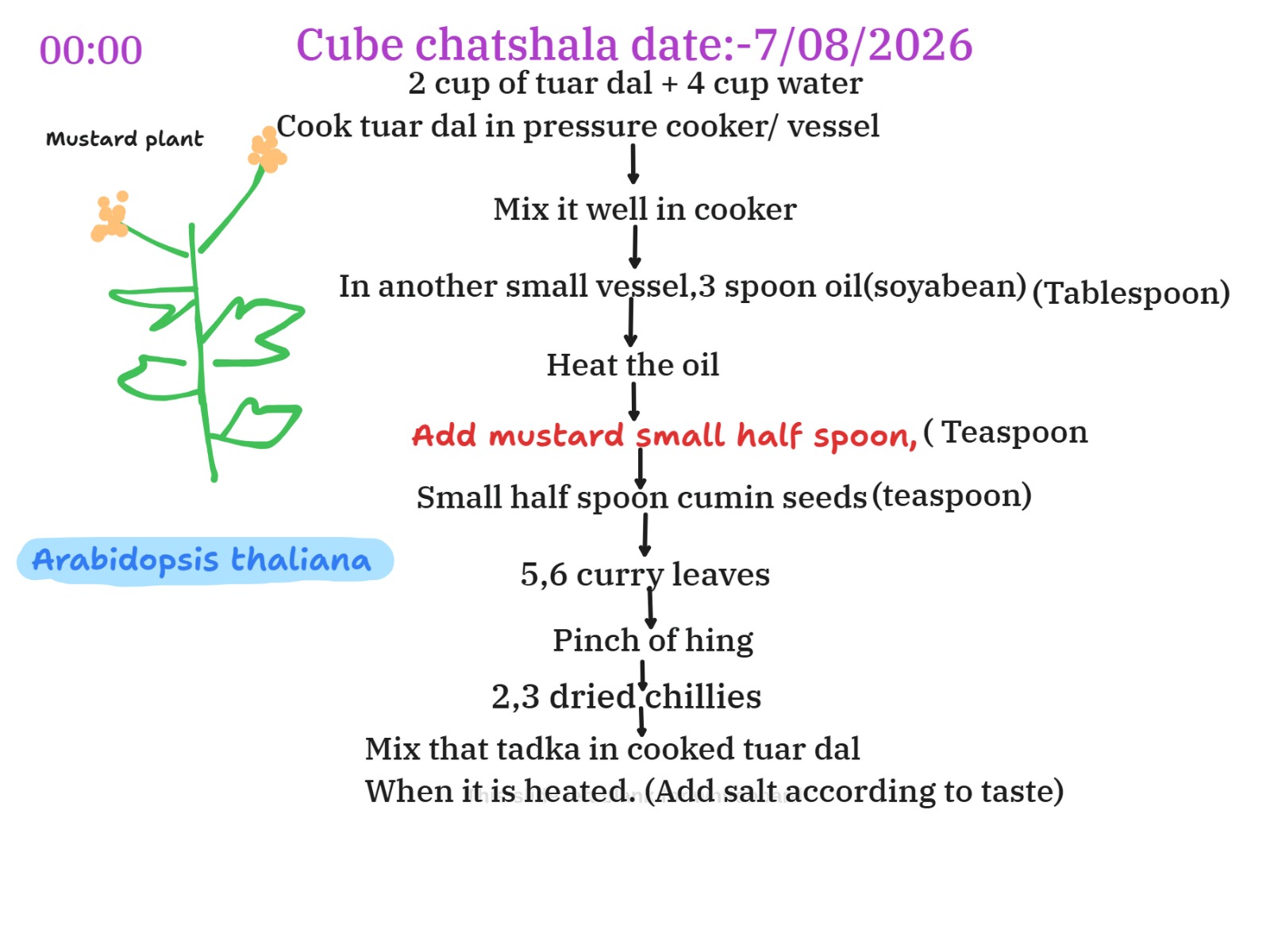
The session opened with Manali walking everyone through her mother’s tuar dal recipe, step by step, right from soaking two cups of dal in four cups of water, cooking it in a pressure cooker, and then preparing a separate tadka using soyabean oil, mustard seeds, cumin seeds, curry leaves, a pinch of hing, and dried chillies. What looked like a simple cooking demonstration quickly turned into a springboard for a much bigger conversation. Someone pointed out that the mustard seeds sputtering in the hot oil are actually seeds of a flowering plant, and from there the discussion pivoted entirely to Cardamine and its cousin, mustard, both members of the Brassicaceae family.
Arunan sir and Kiran mam guided the participants through why Cardamine has become such a favourite subject for CUBE’s citizen scientists. As documented on Metastudio, Cardamine is a small flowering plant in the Brassicaceae family, closely related to mustard, cabbage, cauliflower, turnip, broccoli, and, notably, Arabidopsis thaliana, the classic model organism used worldwide in plant genetics research. The participants discussed how, unlike Arabidopsis, which is a European species requiring controlled lab conditions to grow in India, Cardamine thrives freely across the country in ordinary soil and humidity, making it a far more accessible, homegrown alternative for hands-on plant science.
The whiteboard notes from the session (see the hand-drawn diagram) reflect exactly this dual thread: a recipe flowchart running down one side, with a sketch of the mustard plant and the label “Arabidopsis thaliana” placed right alongside it, a visual reminder that today’s discussion moved fluidly between the kitchen and the herbarium.
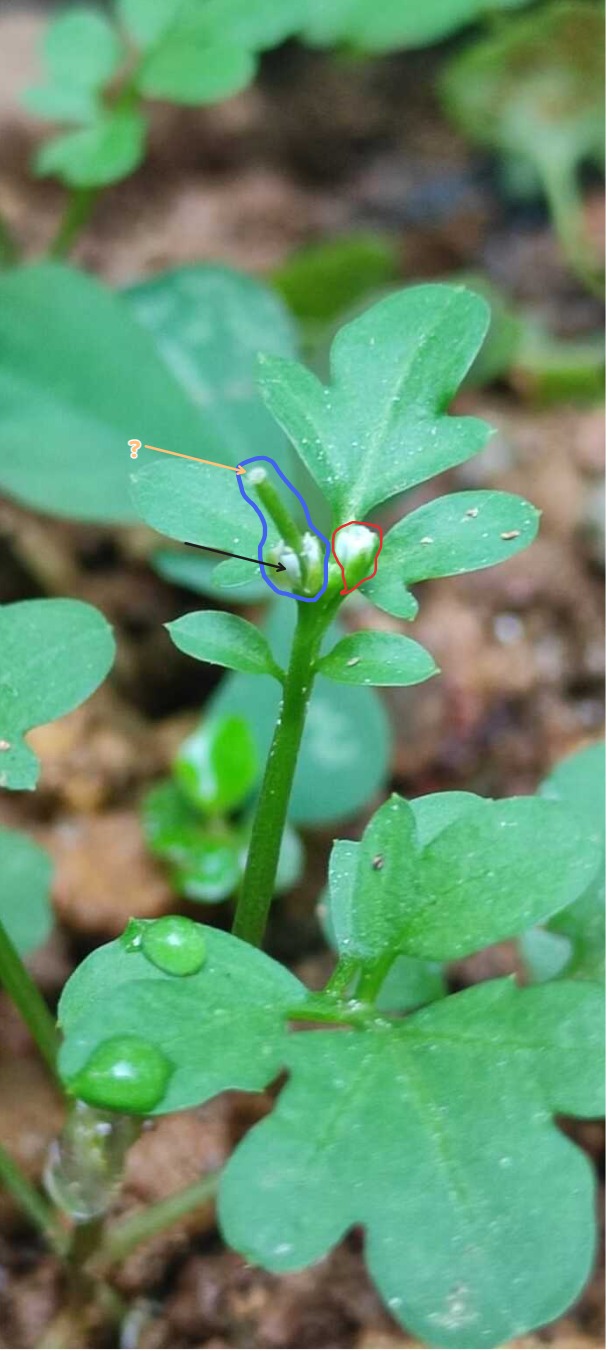
The conversation also touched on the seasonal life cycle of Cardamine, sometimes called a “monsoon fast plant” in earlier CUBE sessions because of how quickly it germinates, flowers, and sets seed once the rains begin. Members shared close-up photographs of young seedlings, with markings on the leaf axils pointing to structures the participants wanted to identify together, likely early floral buds or emerging leaf primordia, judging by the annotated image shared in the session. This became one of the more genuinely uncertain, exploratory moments of the day, since not everyone was confident about what exactly those small white structures represented.
Participants for the day included Manali Bhujade, Sailekshmi, Arunan MC, Niharika, Kiran, Chanchal, Sujal, Chitralekha, Rechel Tirkey, and Ajita, spanning locations from Mumbai to Ranchi, a good reflection of how geographically distributed this citizen science community really is.
 Provocative Questions
-
If Cardamine germinates and flowers so much faster than Arabidopsis, what trade-offs might researchers face when using it as a substitute model system for genetic studies?
-
Mustard seeds release their pungency only when crushed and mixed with liquid. What does this tell us about how plants store and protect their chemical defences until needed?
-
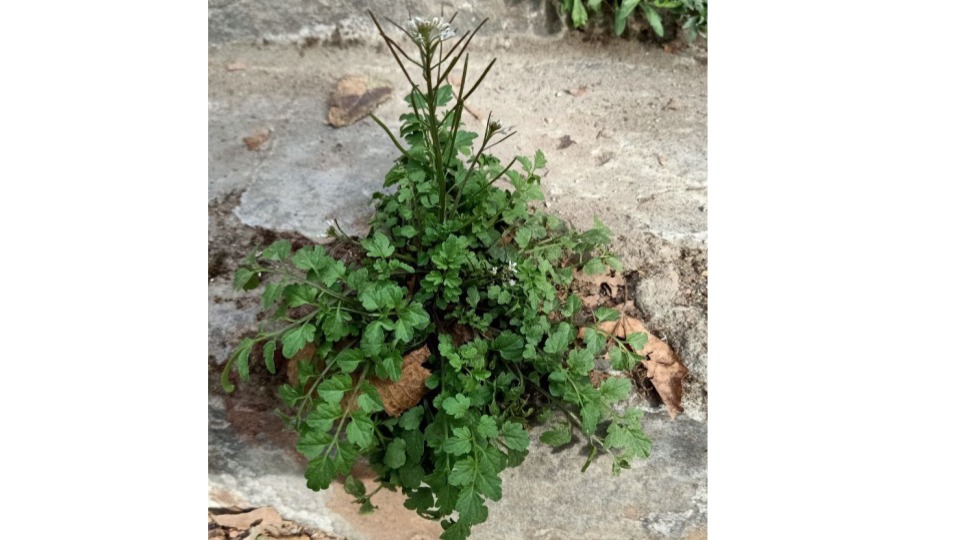
Cardamine grows unaided through cracks in stone and grow-bag pores across wildly different Indian climates, from Kerala to Assam. What does this resilience suggest about the evolutionary advantages of being a “weed”?
-
Why might a plant family that gives us food staples like cabbage, broccoli, and mustard also be the source of one of science’s most important model organisms?
-
Looking at the annotated seedling photograph, how would you design a simple, low-cost method to confirm whether the marked structure is a floral bud or a leaf primordium?
 What I Have Learned
Sitting through this session reminded me how much science hides inside the most routine domestic acts. I’ve made tadka more times than I can count, but I had never really stopped to think about the mustard seed as a plant reproductive structure, let alone connected it to a research-grade model organism growing in courtyards and pavement cracks around us. That’s the real value of ChatShaala for me: it keeps pulling ordinary experience back into a scientific frame.
I also came away with a sharper appreciation for why Cardamine matters so much to the CUBE community specifically. Arabidopsis is powerful but geographically limited in India without artificial climate control, so having a close relative that grows wild and fast, right here, right now, without any lab infrastructure, genuinely democratizes plant genetics as a citizen science activity. It is one thing to know a fact like that in the abstract, and another to hear it discussed by people who have actually raised Cardamine on their own balconies and windowsills.
 TINKE Moments (This I Never Knew Earlier)
First, I now know explicitly that the pungency of mustard is not present in the intact seed. It is generated only when the seed is crushed or heated, since that action brings enzymes and a precursor compound into contact with each other. I had always treated “mustard flavour” as a fixed property of the seed rather than a chemical reaction triggered by preparation.
Second, I now know explicitly that Cardamine and mustard are not just loosely similar-looking plants but true taxonomic relatives within Brassicaceae, sharing that lineage with Arabidopsis thaliana. Before today, I would have assumed the resemblance was coincidental or purely visual.
Third, I now know explicitly that model organisms are chosen as much for practical accessibility as for their genetic properties. Cardamine’s appeal isn’t that it’s scientifically superior to Arabidopsis in every way, but that it solves a very real logistical problem: growing a genetically tractable plant without a controlled greenhouse.
 Gaps and Misconceptions
Despite the productive discussion, a few open questions remained unresolved. There was genuine uncertainty in the participants about the exact structures marked in the annotated seedling photograph, whether they represented very early floral buds, axillary meristems, or something else entirely, and nobody offered a fully confident identification during the session. This is worth flagging honestly rather than papering over, since it’s a good example of the kind of observational ambiguity that real fieldwork throws up.
There was also no explicit clarification during the session of how closely related Cardamine hirsuta specifically is to the mustard varieties used in Manali’s recipe, since “mustard” as a culinary term covers several different species. Conflating all mustard-family plants into a single category is a simplification the participants seemed to lean on without fully unpacking it, and it would be worth revisiting in a future session with a proper species-level comparison.
 Photographs during Chatshaala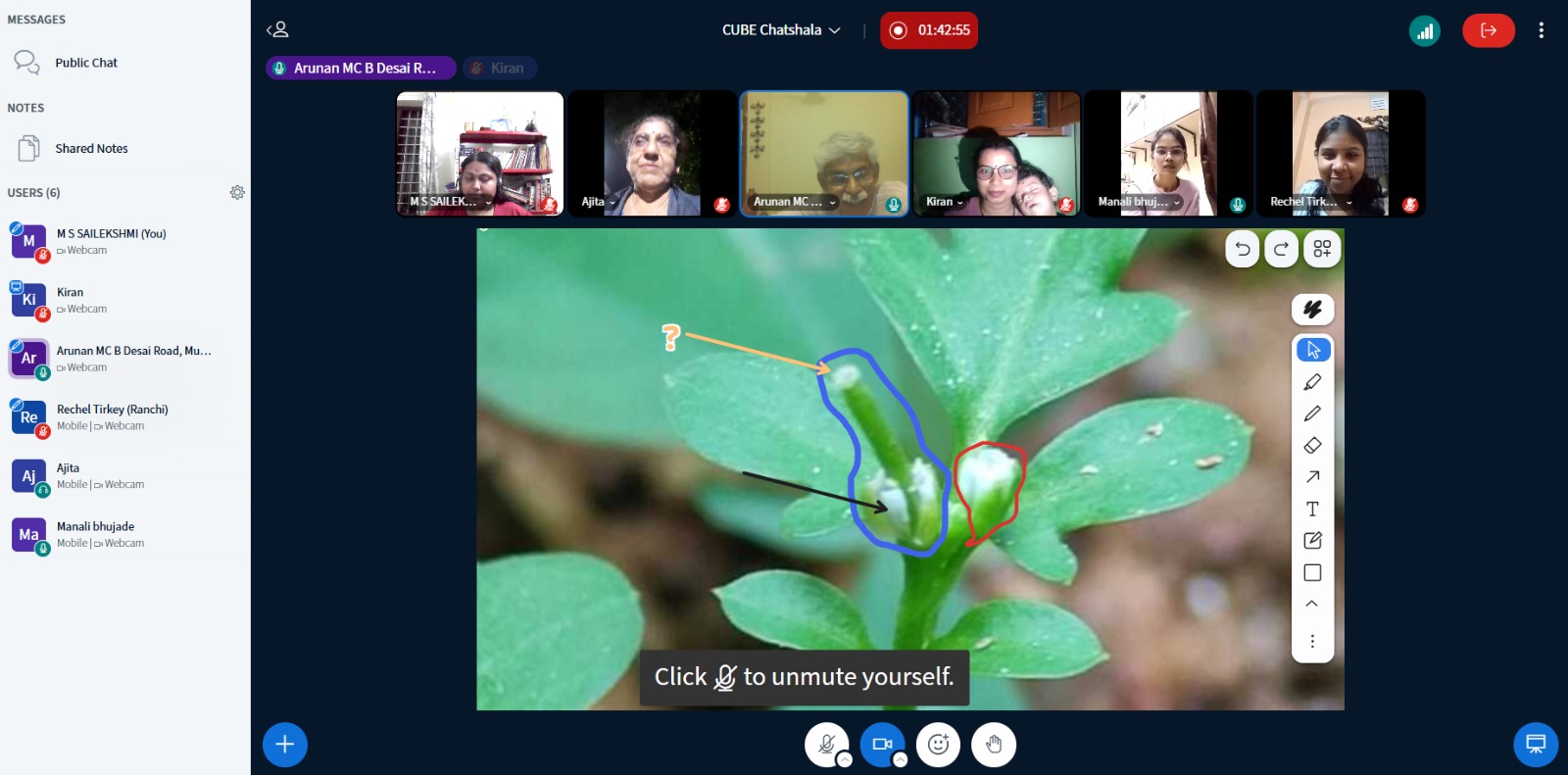

 Reference