 CUBE Chatshaala - Discussion Summary
CUBE Chatshaala met on 22 October 2026 with seven participants: Niharika Baghari, Kiran Kalakoti, Arunan MC, Prithviraj, Susanta Tanti, Khushbu Gupta, and Sailekshmi. The session moved between two themes: a mango phenology observation and the diversity of earthworms.
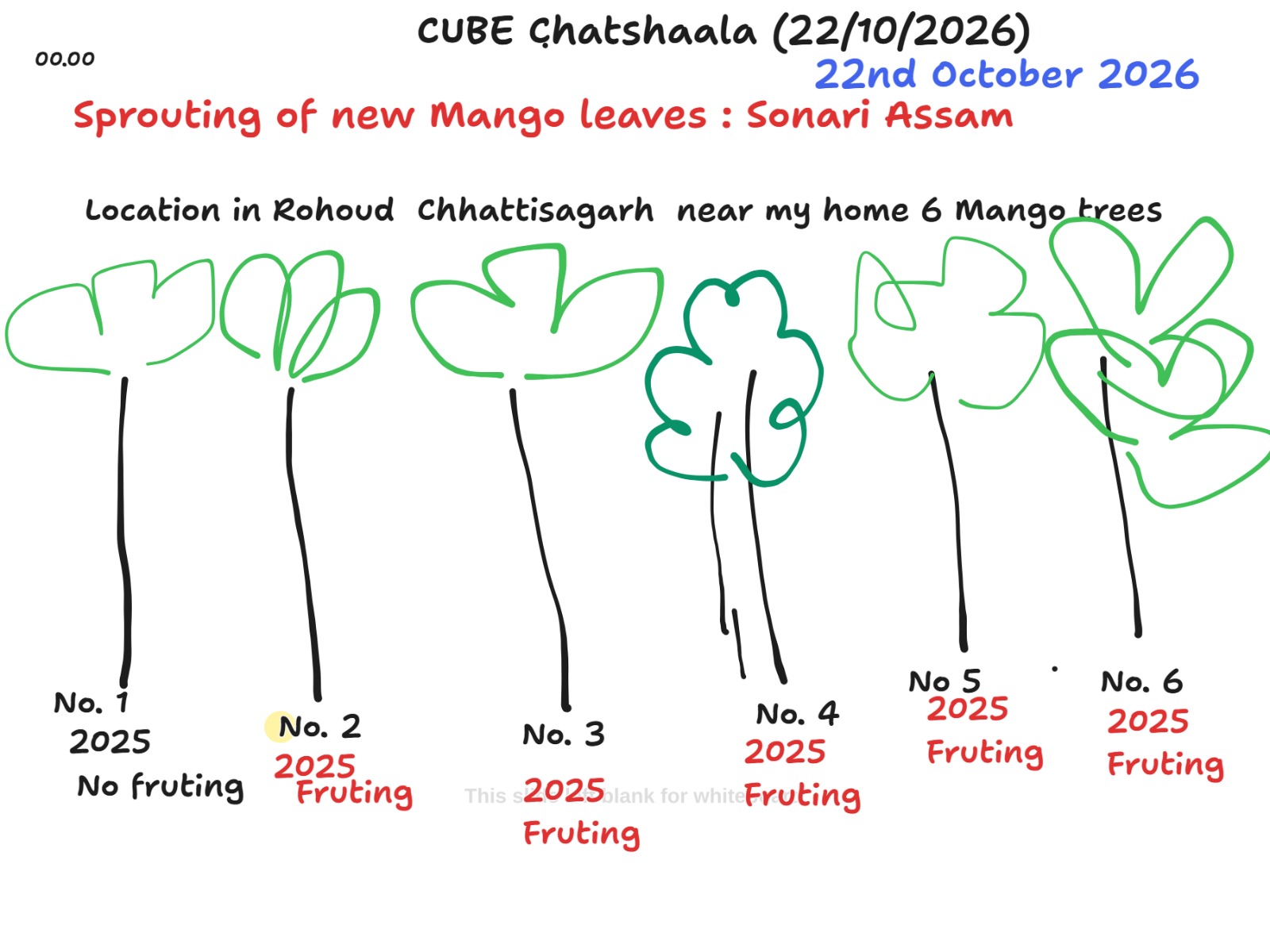
The first whiteboard slide was titled “Sprouting of new Mango leaves: Sonari Assam”. Underneath, the presenter noted that the observation site is near their home in Rohoud, Chhattisgarh, where six mango trees were being watched. Each tree was sketched as a numbered trunk with a crown of fresh green leaves, and each carried a note on its 2025 fruiting record. Tree No. 1 had not fruited in 2025. Trees No. 2 to No. 6 had all fruited. Five of the six trees (about 83 percent) therefore produced fruit last year, while one skipped a season. The key point is that the trees are now putting out new leaves, so the discussion centred on what this leaf flush means in the yearly cycle of a mango tree, and on whether last year’s fruiting history says anything about what each tree will do next.
This connects to earlier CUBE work. The reference thread on the Republic Day Mango Map (January 2024) invited Cubists across the country to record the mango trees around them. Related threads from that exercise, including the Mango Map data analysis discussion, noted that Kerala records showed flowering beginning as early as August, while records from Assam, such as Sapekhati, often showed no flowering when other regions had started. Earlier Chatshaala discussions also suggested that a tree in one’s immediate surroundings, watched for many years, can answer questions that a one-time survey cannot. Six trees in a single compound is exactly that kind of record. Published horticultural sources add that mango flowering depends on weather, especially cool temperatures, and on the maturity of the terminal shoots, and that some trees flower heavily one year and lightly the next.
Rechel Tirkey (Ranchi) shared that her TINKE moment was learning that earthworms can be found on trees too. Most of us picture earthworms only in garden or field soil, so this widened the idea of where they live. Some earthworms occupy arboreal habitats, such as humus gathered in tree forks, decaying bark, tree holes, and soil trapped around epiphytes. This is a good reminder that the soil layer is not the only place to look when we survey earthworm diversity.
The second part of the day was a webinar titled as an introduction to the earthworms of Kerala, which ended at 8:40 pm. The whiteboard slide for it carried the heading “Varieties of earthworms”. The background notes shared for the session describe a researcher from Mahatma Gandhi University, Kottayam, who works on the taxonomy, distribution, and biogeography of earthworms, mainly the families Moniligastridae and Megascolecidae across the Western Ghats, Kerala, and South Asia. They mention the genus Aiyeriella (Narayanan and Julka, 2025), described as only the second earthworm genus named from Kerala since independence. They also describe the university’s earthworm collection at ACESSD, which holds over 21,000 specimens and 135 species, 93 of them recorded from Kerala, along with work on earthworm ecology, invasive species, and pesticide toxicity. A 2023 Metastudio thread on collecting, culturing and maintaining earthworms was shared as a practical companion. Together, these showed that “earthworm” covers a large and still incompletely documented group, and that Kerala alone holds a considerable share of it.
 Provocative Questions
-
A leaf flush and a flowering flush are different events. How can a home observer tell them apart on the same tree, and which one should be recorded first?
-
Tree No. 1 skipped fruiting in 2025 while its five neighbours fruited. Is that alternate bearing, a difference in the tree itself, or simply chance in a sample of six?
-
If all six trees stand within walking distance, why might they still behave differently? What would we measure to find out?
-
Does the new leaf growth in October point to a tree that rested after fruiting, and could it predict flowering in the coming months?
-
The board names Assam while the trees are in Chhattisgarh. What would a comparison between the two places need to hold constant to be fair?
-
If a country can have more than a hundred earthworm species in one museum collection, how would a school student begin to tell two varieties apart?
-
When a new genus is described from a state that has been surveyed for decades, what does that say about how much of our local biodiversity is still unnamed?
-
Could a citizen science group contribute to earthworm taxonomy, or does the work depend entirely on preserved specimens and expert examination?
-
If earthworms can live on trees, how would we design a survey that looks above the ground as well as below it?
What I Have Learned
The most useful lesson was how much a simple record can say. Six trees, one note each on last year’s fruiting, and a sketch of this year’s leaves already form a small dataset with a question inside it. I learned that observation becomes science only when it is written down by tree, by year, and by event, so that next season’s notes can be compared with this season’s.
I also learned to keep the stages of a mango tree’s year separate in my head. New leaves, flowers, and fruit are different stages, and a tree can be doing one without the others. Calling every change “flowering” would blur the data, as an earlier Chatshaala found when fruiting had to be separated from flowering in a percentage calculation.
On earthworms, I learned that the group is far larger than the single garden worm most of us picture, and that naming a species or a genus is slow, careful work built on collections kept over many years. The numbers in the shared notes, 135 species in one collection and 93 of them from Kerala, made that visible. And some living in the trees
Finally, I learned that these two topics share a method. Both begin with looking closely, recording honestly, and comparing across places and seasons.
 TINKE Moments (This I Never Knew Earlier)
-
A tree that does not fruit in one year is not necessarily unhealthy. Mango trees are known to vary in how much they flower from year to year, so Tree No. 1 is a question to follow, not a failure to explain away.
-
New leaf growth in October is a separate event from flowering. Seeing green sprouts did not tell us anything yet about flowers or fruit, and the board made that distinction explicit.
-
A small sample can still be a research design. Six trees recorded over several years can show a pattern that a single large survey, taken once, would miss.
-
A new genus of earthworm was named as recently as 2025 from Kerala, a state with a long history of biological study. Taxonomy is still an active field, not a finished catalogue.
-
The same family names, Moniligastridae and Megascolecidae, cover many different earthworms, so “variety” in earthworms really means a range of families, genera, and species.
 Gaps and Misconceptions
Gaps: The mango board recorded 2025 fruiting but gave no dates for the current leaf flush, no variety names for the six trees, and no information on tree age, size, spacing, or care. Without these, we cannot judge whether Tree No. 1 differs from the rest for a real reason. The heading mentions Sonari, Assam, and the board does not say how that place relates to the Chhattisgarh trees, so the intended comparison remains unclear. A single year of fruiting data also cannot confirm alternate bearing, which needs at least two or three consecutive seasons. For earthworms, the slide was left blank apart from its title, so the actual varieties were not listed, drawn, or compared. Features used to separate earthworm groups, such as body segments, the clitellum, and bristle arrangement, were not set out.
Misconceptions: One common assumption is that every healthy mango tree flowers and fruits every year, which the literature and our own data both contradict. Another is that new leaves mean flowers are coming, when the two are different developmental events. A third is that a tree that did not fruit is a diseased tree. On the earthworm side, many people assume all earthworms are the same animal and that a species list must already be complete. The shared notes show neither is true.
Gaps: The mango board recorded 2025 fruiting but gave no date for the current leaf flush, no variety names for the six trees, and no details on tree age, size, spacing, or care. Without these, we cannot judge whether Tree No. 1 differs from its neighbours for a real reason. The heading mentions Sonari, Assam, while the trees are in Chhattisgarh, and the board does not explain how the two places relate, so the intended comparison remains unclear. One year of fruiting data also cannot confirm alternate bearing, which needs at least two or three consecutive seasons of records.
For earthworms, the whiteboard recorded only the heading “Varieties of earthworms”, so the varieties and the features used to tell them apart, such as body segments, the clitellum, and bristle arrangement, are not captured in the notes available for this write-up. Because the webinar was an introduction, a natural next step for the group is a more detailed session on identifying common Kerala earthworms and their habitats.
Misconceptions: One common assumption is that every healthy mango tree flowers and fruits every year, which published horticultural sources and our own earlier Mango Map data both contradict. A second is that new leaves mean flowers are on the way, when leaf flush and flowering are separate developmental events. A third is that a tree that skipped fruiting must be diseased, whereas irregular bearing is a recognised pattern in mango.
 Photographs during Chatshaala

 Referance