 CUBE ChatShaala Summary | 14 December 2025
 Key Discussion
Today’s ChatShaala unfolded as a carefully layered exploration of biotechnology literacy through everyday experiments, blending personal learning journeys with globally relevant scientific and ethical questions.
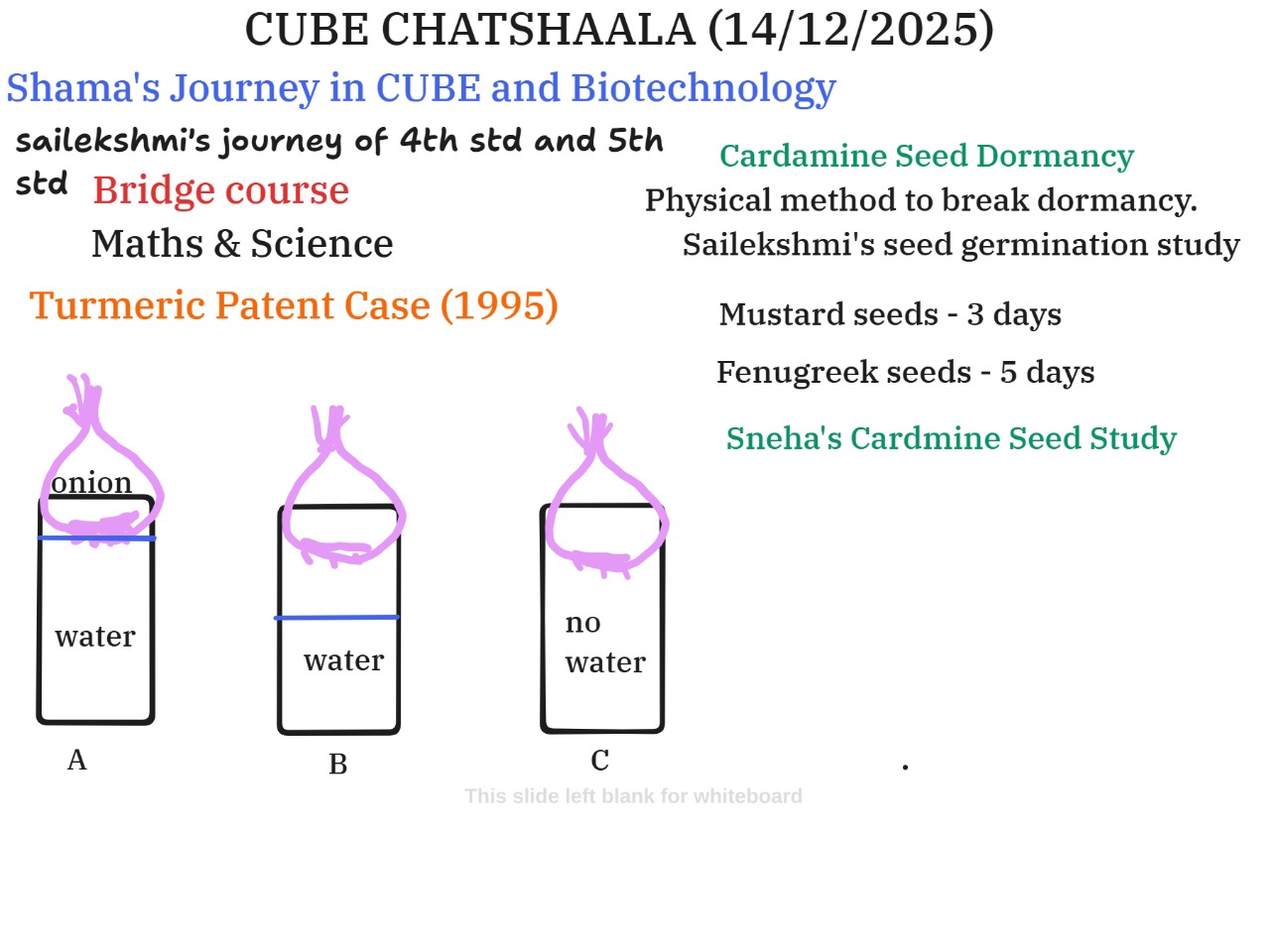
The session began with Shama’s journey in CUBE, highlighting how early exposure through foundational courses in biotechnology and scientific thinking such as Bioethics, Patent, and Bioprivacy.This is seamlessly connected to Sailekshmi’s learning trajectory of the bridge course during 6th grade, as it recalls the math and science concepts from earlier classes., demonstrating how curiosity-driven inquiry matures into structured experimentation.
A significant conceptual anchor was the Turmeric Patent Case (1995), used to discuss biopiracy, traditional knowledge, and the importance of documenting indigenous science. This set the ethical tone for the biological investigations that followed.
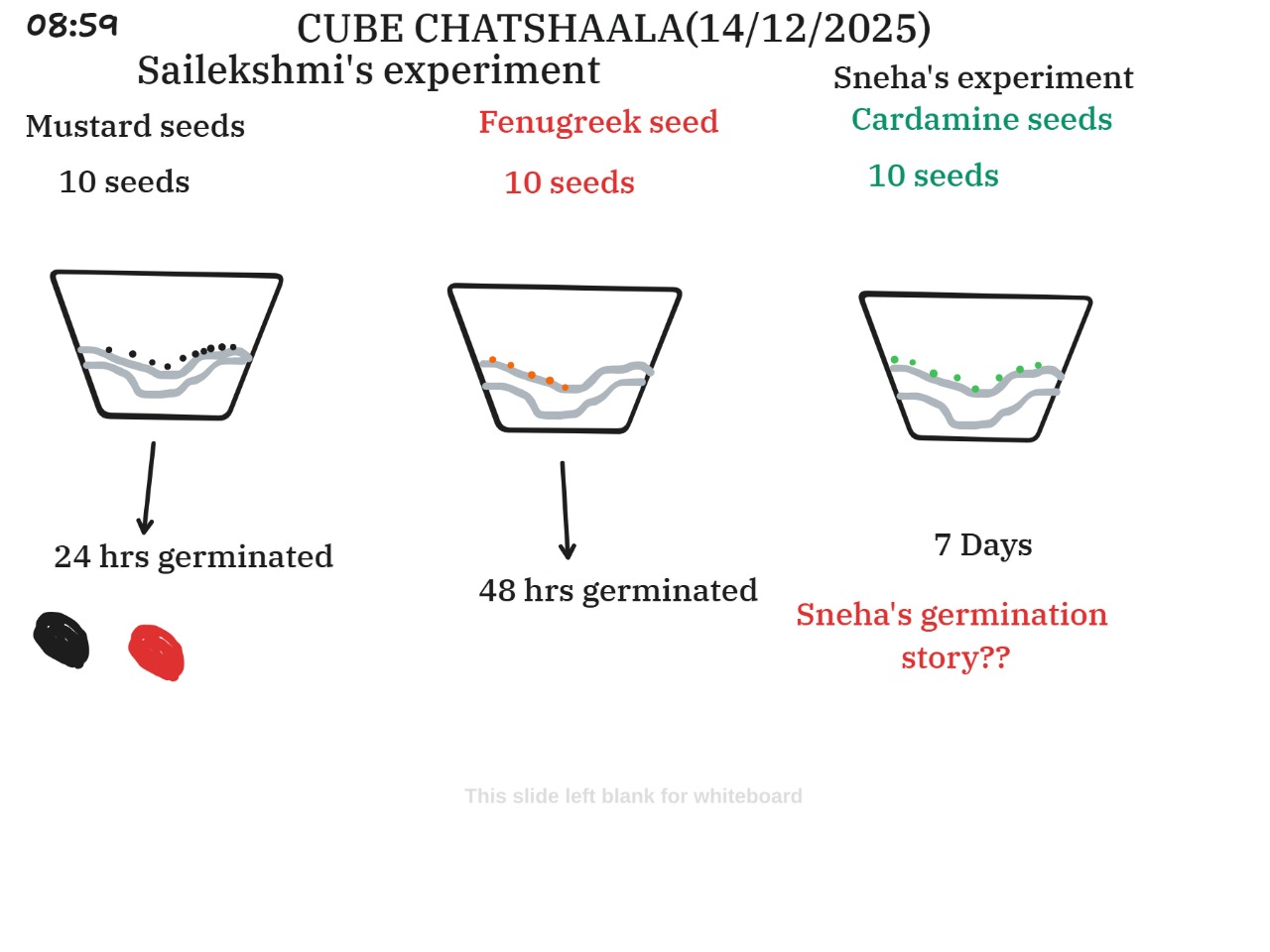
The experimental core focused on seed germination and dormancy, comparing:
- Mustard seeds (rapid germination within ~24 hours),
- Fenugreek seeds (germination around 48 hours),
- Cardamine seeds (delayed germination up to 7 days due to dormancy).
Using simple setups—moist substrates, controlled water availability, and time tracking—the session illustrated how water availability, seed coat properties, and innate dormancy mechanisms influence germination rates.
An auxiliary demonstration using onion structure and water availability reinforced the principle that life processes respond precisely to environmental conditions, not merely the presence of biological material.
Overall, the meeting bridged hands-on observation, theoretical biology, ethics, and scientific communication, embodying the spirit of ChatShaala as a thinking laboratory rather than a classroom.
 What I Learned
-
Germination speed is not a measure of seed “strength” but of adaptive strategy.
-
Dormancy is an active survival mechanism, not a failure to grow.
-
Simple home experiments can mirror questions addressed in advanced genetic research.
-
Scientific ownership and ethics are as crucial as experimental results.
-
Observation becomes science only when paired with documentation and questioning.
 TINKE Moments (Things I Never Knew Earlier)
-
Cardamine’s dormancy makes it a powerful model organism in genetic studies.
-
Fenugreek and mustard differ not just in time, but in water absorption dynamics.
-
Onion tissues visually demonstrate osmotic balance in real time.
-
Traditional knowledge, when undocumented, can be legally misappropriated.
-
Waiting is sometimes a biological instruction, not a delay.
 Gaps and Misconceptions Identified
-
Misconception: Faster germination means better seeds.
Reality: Slower germination often signals evolved environmental intelligence. -
Misconception: Dormant seeds are inactive.
Reality: Dormancy involves active biochemical regulation. -
Gap: Limited understanding of how experimental controls affect outcomes.
Need: Clear distinction between variables (water, time, substrate). -
Gap: Ethics often seen as separate from science.
Need: Integrating ethical reasoning into every scientific discussion.
 Provocative Questions for Reflection
- If a seed knows when not to grow, what does that teach us about learning and patience?
- Who owns knowledge that has existed for centuries—those who document it or those who lived it?
- Can a kitchen experiment challenge the way we understand global biotechnology?
- Is dormancy nature’s way of saying “not yet”?
 Photographs during Chatshaala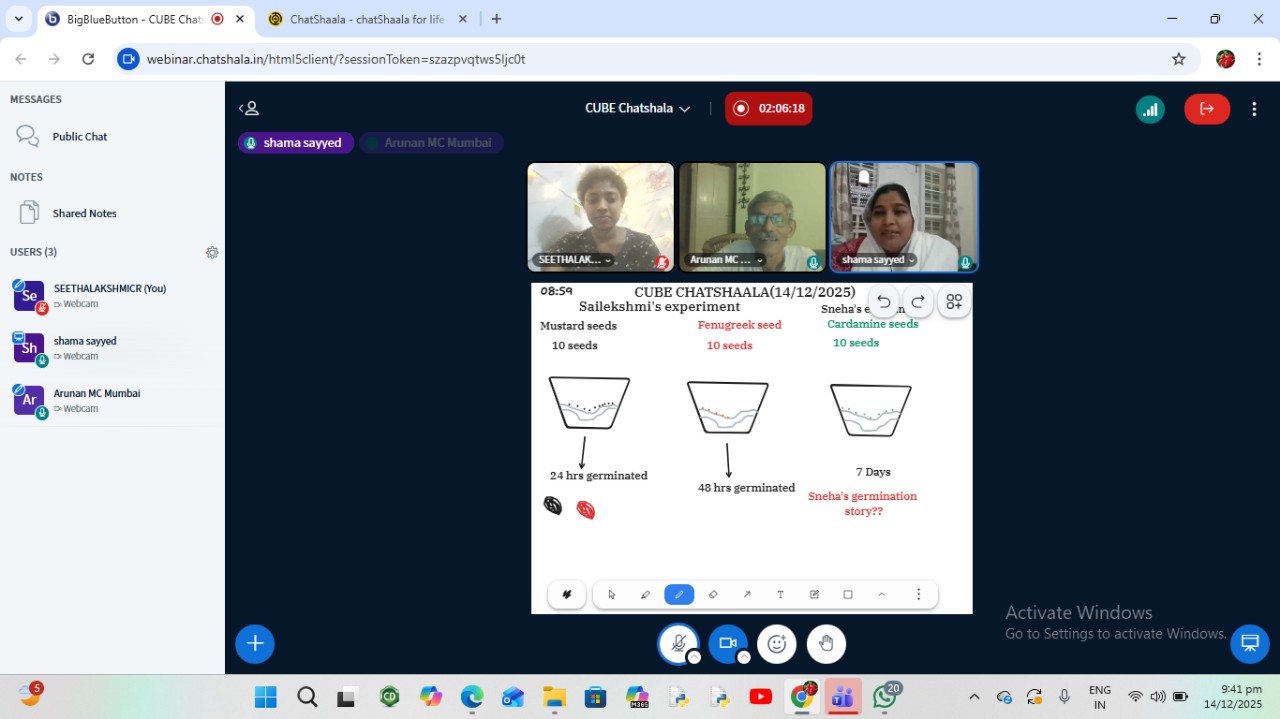
 Reference